peer
peer
The short version
More content will not win an omnichannel buyer's attention. A curriculum will. It sequences your point of view, ends with a credential, feeds every channel from one source, and writes what each buyer learned to the CRM.
Count the channels your last closed-won deal touched before anyone booked a call. Organic search, a LinkedIn post a colleague shared, two webinars, a comparison page, an AI assistant's summary of your category, a partner's recommendation, a review site. Ten touches is a normal number now. Twenty is not unusual.
Inbound marketing was built for a buyer who found you through a blog post and then read your emails. That buyer still exists. They are just one path among a dozen, and every path wants its own content, its own cadence and its own measurement. Most teams answer by producing more: more posts, more clips, more nurture branches. Output rises. Attention per piece falls.
Why more content stopped compounding
Inbound worked because content compounded. A useful article kept earning traffic for years. That math broke in three places.
Channels multiplied faster than teams
The same five marketers who ran a blog and an email program now run search, social, video, community, events, partner marketing and AI search optimization.
Answer engines sit in the middle
Assistants build answers from sources they trust. A keyword post is a weak signal. A structured, open lesson that explains a method is a strong one.
Buyers do the assembly
Content without a sequence leaves the buyer to connect your post, a competitor's post and a consultant's thread. Nobody taught them how the pieces fit.
A curriculum is content with an order and a finish line
A curriculum does three things a content calendar cannot.
It sequences
Lesson two assumes lesson one. Your point of view becomes the frame the learner uses to judge everyone else.
It finishes
An exam and a credential give the buyer a reason to come back, and give you a signal that means something: this person completed the method.
It feeds every channel
One lesson becomes a search page, a clip, three posts, a sales card and a nurture email. The channels change. The teaching stays the same.
What HubSpot Academy's program data shows
HubSpot proved this at scale. Its Academy grew out of a webinar series in 2012 and became the company's largest acquisition engine. The courses taught the inbound method, and practitioners who learned the method went looking for software built to run it. (Sources for these figures are on the Peerfold Loop page.)
Where the Loop fits
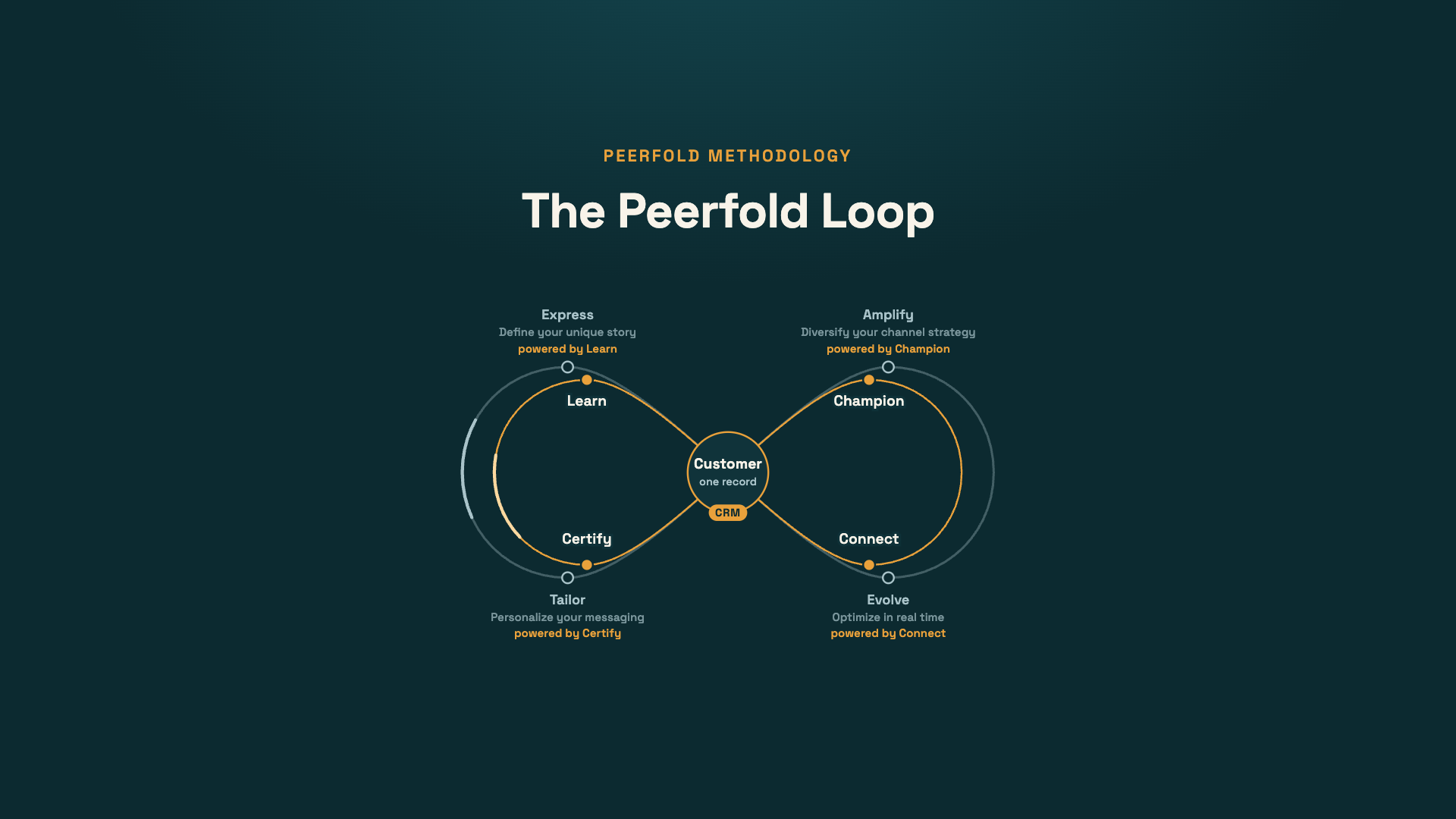
HubSpot's Loop Marketing playbook describes four stages: Express, Tailor, Amplify and Evolve. The Peerfold Loop nests an education flywheel inside each one: Learn, Certify, Champion and Connect.
Express pairs with Learn, and it is where an inbound marketing strategy starts. Your curriculum is your story. The strongest way to express a point of view is to teach it, in order, with a test at the end. Three plays from that stage apply to any inbound team this quarter.
Stage 01 · Express × Learn
Three plays to run this quarter
Name the problem before anyone else does
Give your buyers' costly, unnamed problem a name and build the first lesson around it. The team that names a problem usually owns the category around it.
Teach the job, not the tool
Most lessons should help someone who never buys. Where the product appears, it appears as the worked example. Buyers smell a disguised demo in one paragraph.
Build for citation
Keep lessons open, structured and specific. A gated PDF is invisible to answer engines. Track share-of-answer: how often AI answers in your category cite you.
Every lesson has to write to the record
A curriculum that lives in a separate tool breaks the loop. If lesson completions, quiz results and credentials never reach the CRM, marketing sees a download, sales sees nothing, and customer success starts from zero.
When a prospect finishes lesson three, the contact record should say so. When they pass the exam, lifecycle stage, lead score and the next sales conversation should all change. That is the difference between a course and a content library with a progress bar.
The rule that holds the model together
Every turn of the loop writes to the record. You cannot control which of twenty channels a buyer uses next. You can make sure that whatever they learned on any of them lands in one place.
What to do in the next 90 days
Keep the first pass small.
Name the problem. Write down the one problem your market has no good name for, and name it.
Outline five lessons. Teach the method for solving it. Put the product in lesson four as an example, nowhere else.
Add proof. A real exam and a shareable credential at the end.
Wire the data. Connect completions and credentials to contact records before you launch.
Cut for channels. Each lesson becomes one search page, one clip, three posts and one email.
Read the drop-offs. Once a month, find where learners stop and fix the worst lesson first.
Then measure what changed: course starts by channel, completion rate, pipeline influenced by credentialed contacts, and how often assistants cite your lessons.
Questions teams ask
Is inbound marketing dead?
No. The inbound method still works. What changed is the number of places a buyer learns before they talk to you. Inbound now needs a structure that reaches all of them.
Does a course replace the blog?
No. The blog becomes the front door to the course. Articles like this one answer a single question and point to the full method.
How long should the first course be?
Short enough to finish in a week. Five to seven lessons and one exam is enough to start collecting signal.
The Peerfold Loop course
Learn the full method
The Peerfold Loop course teaches all four stages of education-led growth inside HubSpot's Loop Marketing, with every play in this article and twenty-five more.
- Four stages and twenty-eight plays
- Narrated lessons with stage quizzes
- Practitioner exam and verifiable credential
- Open access